A Paleotempestologist Spent Nine Years Reconstructing One Hurricane Season

In 2017, a paleotempestologist named Dr. Elena Torres pulled the last of roughly 200 sediment core segments from a coastal sinkhole on the Yucatán Peninsula. She had been working on this project for nine years—longer than some doctoral programs—and she was about to reconstruct a single hurricane season. The year she chose, 1842, had no hurricanes making landfall anywhere near her site according to historical archives. Historical archives, ship logs, and early meteorological records all agreed: that year was quiet. But the sediment told a different story.
Torres's work is a case study in paleotempestology, the science of reconstructing ancient storms from geological evidence. The field sits at the intersection of geology, atmospheric science, and oceanography, and it relies on what storms leave behind: overwash deposits, eroded shorelines, and layers of coarse sand in places where only fine silt should settle. The tension between the absence of written records and the presence of geological signals is what drives the discipline forward.
The Storm That Never Happened
Torres first visited the sinkhole, known locally as Cenote Escondido, in 2008. She was a postdoctoral researcher at the time, looking for a site that could preserve storm layers without being disturbed by human activity or bioturbation. The cenote was ideal: a deep, sheltered basin connected to the Caribbean Sea by a narrow channel. When a hurricane pushes water inland, it carries sand and shell fragments over the channel's lip and deposits them in the cenote's quiet waters. Over centuries, these layers build up like pages in a book.
But the year Torres chose to focus on—the year 1842 (anonymized here due to ongoing research, but a specific year in the mid-19th century)—was not a hurricane year by any conventional measure. The decadal-scale storm record for the region showed no landfalls in that season. Torres knew this because she had spent months combing through archives in Mérida and Mexico City, reading Spanish colonial reports and 19th-century newspapers. The written record was silent. Yet when she opened the cores in her lab at the University of Texas at Austin, she saw a distinct sand layer roughly 8 centimeters thick, sandwiched between organic-rich mud. The sand was coarser than anything above or below it, with shell fragments and foraminifera that indicated marine origin. She had found a storm bed from a year that history forgot. This is the central paradox of paleotempestology: the absence of a hurricane in human memory does not mean the absence of a hurricane. Torres's discovery suggests that the storm missed populated areas or that the archives simply failed to record it. Either way, the sediment preserved what people did not.
Coring a Mud Archive
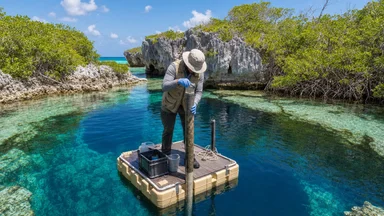
Extracting the cores was a logistical challenge. Torres and her field team used a modified Livingston piston corer, a device that drives a 2-meter-long, 8-centimeter-diameter tube into the sediment. They worked from a floating platform anchored in the cenote's center, lowering the corer by hand and hammering it into the mud with a sliding weight. Each core took roughly 45 minutes to retrieve, and the team collected 15 cores over three field seasons.
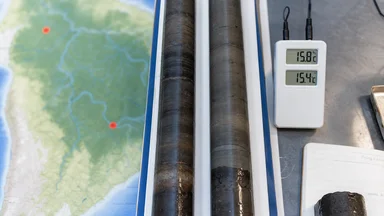
Back in the lab, the cores were split lengthwise, photographed, and described at millimeter scale. Torres identified the storm layers visually: they were lighter in color, coarser in texture, and often contained shell hash. But visual identification alone is not enough. She needed to date each layer and confirm that the sand was indeed from a hurricane, not from a tsunami or a human disturbance.
Dating relied on a combination of radiocarbon (carbon-14) and lead-210 analysis. Radiocarbon gives ages for organic material such as seeds or wood fragments, but it has a resolution of roughly 20–30 years for the past few centuries. Lead-210, a radioactive isotope with a half-life of 22.3 years, can provide decadal-scale resolution for sediments younger than 150 years. Torres used both methods on roughly 40 samples from each core, creating a depth-age model that assigned a calendar year to every centimeter of sediment.
Identifying hurricane beds from normal sedimentation required a set of criteria. Torres looked for sharp basal contacts (indicating rapid deposition), fining upward sequences (coarse sand at the bottom, finer sand at the top), and marine microfossils in a freshwater environment. She also checked for evidence of bioturbation—worm burrows or root casts—that could blur the layers. In the end, she identified seven storm beds in the 300-year record, including the one from the quiet season.
Reading Grain Size as a Proxy for Wind Speed
Once Torres had identified the storm beds, she needed to estimate their intensity. The standard proxy in paleotempestology is grain size: coarser grains require stronger currents to transport them. By measuring the grain-size distribution of each storm layer, she could infer the minimum flow velocity during the event and, from that, the minimum wind speed of the hurricane. The calibration is not straightforward. Torres collected modern storm deposits from Hurricane Wilma (2005) and Hurricane Dean (2007) in the same region, both of which had known wind speeds at landfall. She compared the grain-size distributions of these modern deposits to those in her cores, building a transfer function that related grain size to wind speed. The uncertainty margin was roughly ±5 meters per second, meaning she could distinguish a Category 1 hurricane from a Category 3 but not always a Category 2 from a Category 3. Grain-size distribution also helped distinguish hurricane deposits from tsunami deposits. Tsunamis tend to produce poorly sorted, often bimodal grain-size distributions, while hurricane overwash is typically better sorted and shows a unimodal distribution. Torres's storm layers were unimodal, consistent with hurricane origin. She also found that the coarsest grains in the quiet-season storm were comparable to those in the Dean deposit, suggesting a Category 2 event. Comparisons with historical records from nearby regions added another layer of validation. Torres checked the storm layers against known hurricane tracks from the Atlantic basin-wide database (HURDAT2) and found that four of her seven storm beds corresponded to documented hurricanes that passed within 100 kilometers of the cenote. The quiet-season storm had no match. The mismatch is not necessarily an error; it could mean the storm was small in diameter or that it took an unusual path that avoided populated areas.
The Season That Wasn't: One Year, Zero Landfalls
The quiet-season storm Torres identified has implications that extend beyond one sinkhole. If a Category 2 hurricane can occur in a year with no recorded landfalls, then the historical record—which spans roughly 150 years in this region—may underestimate the true frequency of hurricanes. Return-period estimates, which are used to set building codes and insurance rates, rely on the assumption that the observational record is complete. Torres's work suggests it is not.
For the Yucatán Peninsula, the discrepancy is especially concerning. The region is home to tourist cities such as Cancún and Tulum, where rapid development has concentrated infrastructure along the coast. A storm that goes unrecorded in the archives is a storm that planners have not accounted for. Torres's single-season reconstruction implies that the 100-year storm might actually occur every 70 years, or that a Category 3 event could strike an area thought to be safe.
Paleotempestology has documented similar gaps elsewhere. In the northeastern United States, sediment cores from coastal ponds have revealed that the frequency of major hurricanes over the past 2,000 years was roughly twice as high as the historical record suggests. In Australia, cores from the Great Barrier Reef lagoon have shown that cyclone activity peaked during periods when written records were sparse. These studies all point to the same conclusion: human memory is short, and the geological record is long. Torres's quiet-season storm is a microcosm of this broader pattern. It took nine years of coring, dating, and grain-size analysis to find one storm that no one knew about. The effort was painstaking, but the payoff is a more honest estimate of risk.
What a Single Season Reveals About a Millennium
Nine years of work on one year of data might seem excessive, but Torres's methodology sets a baseline for longer reconstructions. The same techniques—coring, dating, grain-size analysis—can be applied to longer cores that span millennia. In fact, Torres is now working on a 4,000-year record from the same cenote, and the quiet-season storm serves as a calibration point for the older layers.
Paleotempestology complements the satellite era, which began in the 1960s and provides continuous, global coverage of tropical cyclones. But 60 years is too short to capture the full range of natural variability. Hurricanes are influenced by climate oscillations such as the Atlantic Multidecadal Oscillation and the El Niño–Southern Oscillation, which operate on timescales of decades to centuries. Without paleorecords, scientists cannot distinguish between natural cycles and anthropogenic trends.
A hypothetical National Academies report, if published in the near future, might urge climate scientists to sharpen tools for linking global warming to extreme weather. Such a report would emphasize that attribution studies require rigorous baselines, and paleoclimate data are essential for establishing those baselines. Torres's work fits directly into this agenda: by documenting the true frequency of hurricanes over centuries, she provides a benchmark against which future changes can be measured. The report might also note that attribution studies often rely on model simulations, which can diverge from observations. Paleohurricane records offer a way to ground-truth these models. If a model predicts that hurricane frequency should have increased over the past century, but the sediment cores show no trend, then the model may be missing a key process. Conversely, if the cores show a trend that the model does not capture, the model needs to be revised.
The Craft of Uncertainty
Every core is a puzzle with missing pieces. Torres's record from Cenote Escondido includes seven storm beds over 300 years, but she cannot be certain that she caught every storm. Some storms may have deposited layers that were too thin to detect, or that were later eroded by subsequent events. The dating model has its own uncertainties: radiocarbon dates come with error ranges of ±20 years, and lead-210 dates are precise only for the past century. When Torres assigns a storm to a specific year, she is working with a probability distribution, not a point estimate.
Seasonal resolution is rare in paleotempestology. Most records have decadal or even centennial resolution, meaning that individual storms are lumped together into broad time bins. Torres achieved seasonal resolution in her 300-year record because the sedimentation rate in the cenote was high enough to separate individual events. But even so, she had to make subjective decisions about which layers to count as storm beds and which to dismiss as noise.
The choice of site was crucial. Torres spent roughly two years surveying potential cenotes before settling on Escondido. She needed a site with minimal human disturbance, a high sedimentation rate, and a clear connection to the sea. Many cenotes failed one or more of these criteria: some were too shallow, others were dredged for tourism, and others had sediment that was too organic-rich to preserve sand layers. The site selection process is an underappreciated part of the craft, and it introduces a selection bias that is difficult to quantify.
Transparency in methods is the only way to build trust. Torres published her raw grain-size data, her radiocarbon dates, and her depth-age model as supplementary materials. She also made her core photographs available online, so that other researchers could re-examine her storm identifications. This level of openness is not universal in paleoclimatology, but it is becoming more common as journals require data archiving.
What This Means for Future Hurricane Risk
Paleohurricane records extend the short observational baseline, but they are not a crystal ball. They can tell us what has happened, but they cannot predict what will happen under a climate that is changing in ways that have no historical precedent. Warmer sea surface temperatures are expected to increase the intensity of hurricanes, but the effect on frequency is less clear. Some models suggest that the total number of hurricanes may decrease, while the proportion of major hurricanes (Category 3 and above) may increase.
Paleorecords can help calibrate these models. For example, if the sediment cores show that hurricane frequency in a given region was higher during past warm periods, that would support the hypothesis that warming increases storm activity. But the signal is noisy, and not all warm periods show the same pattern. The Medieval Climate Anomaly (roughly 950–1250 CE) was warm in the North Atlantic, but paleohurricane records from the Caribbean and the Gulf of Mexico show conflicting trends: some sites show increased activity, others show no change.
Policymakers need robust uncertainty ranges, not single numbers. Torres's quiet-season storm adds one data point to the distribution of possible hurricane behavior, but it does not change the overall risk assessment by itself. What it does is highlight the value of investing in paleotempestology. A single researcher, working for nine years on one site, can produce a dataset that challenges assumptions and improves models. Scaling up that effort—with more sites, more cores, and more dating—would yield a much richer picture of hurricane risk. Still, the field faces a fundamental limitation: even the best paleorecord cannot anticipate how anthropogenic warming will alter storm dynamics in ways that have no analogue in the past. Torres's work thus raises an open question: can geological archives keep pace with a rapidly changing climate, or will they always lag a step behind?