Twenty-Year Grant Gap Gave Rodent Fear Studies a Human Reliability Edge

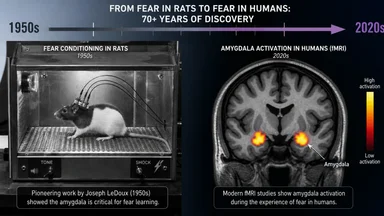
In the early 1950s, a handful of laboratories began conditioning rats to associate a tone with a mild foot shock. The animals froze, their heart rates climbed, and a field was born. By the time human neuroimaging studies of fear took off in the mid-1990s, rodent researchers had already amassed decades of data on the neural circuitry of learned threat. That head start was not accidental. It was underwritten by a sustained funding commitment that human fear research would not see for another twenty years. The gap gave rodent studies a crucial advantage: larger sample sizes, more replications, and a cumulative evidentiary base that human work has struggled to match. But the transfer of paradigms from one species to another carried assumptions that are only now being tested.
When Rodent Fear Research Outpaced Human Studies
Fear conditioning as a laboratory procedure traces back to the 1950s, when researchers like Neal Miller and O. Hobart Mowrer used rats to study avoidance learning. The basic protocol was elegant in its simplicity: pair a neutral stimulus, such as a light or tone, with an aversive event, typically a brief electric shock. After a few pairings, the stimulus alone elicited a conditioned response—freezing, increased startle, autonomic arousal. By the 1970s, the paradigm had become a workhorse of behavioural neuroscience, producing a steady stream of findings about the amygdala, hippocampus, and prefrontal cortex.
Human fear conditioning experiments, meanwhile, were largely confined to psychophysiological measures—skin conductance, heart rate, eyeblink startle—until functional magnetic resonance imaging (fMRI) became widely available in the mid-1990s. The first human fMRI studies of fear conditioning appeared around 1996, roughly forty years after the rodent work began. That lag meant that when human researchers started publishing amygdala activation patterns, rodent researchers had already run thousands of experiments, many with dozens of subjects per group.
The temporal asymmetry was not merely historical. It created a situation in which human neuroscientists often turned to rodent literature to interpret their own results. A cluster of activation in the human amygdala was said to “correspond” to the basolateral nucleus of the rat, based on decades of rodent work. The inference was reasonable but rarely tested directly. The rodent data had a solidity that human data, still thin and variable, could not yet provide.
As one researcher put it, “We were borrowing the rodent story wholesale, because we didn't have one of our own.” That borrowing shaped the questions asked, the protocols used, and the conclusions drawn. It also meant that the reliability of rodent findings was often taken for granted, even as human studies struggled with small samples and poor replication.
The Funding Asymmetry That Shaped Two Fields
The funding trajectories of rodent and human fear research diverged sharply from the 1970s onward. The US National Institute of Mental Health (NIMH) and the National Institute on Drug Abuse (NIDA) invested heavily in animal models of fear and anxiety, motivated by the translational promise of identifying neural targets for pharmaceutical intervention. Grants for rodent fear conditioning studies rose steadily through the 1980s and 1990s, supporting laboratories that could run large numbers of animals at relatively low cost.
Human neuroimaging, by contrast, was expensive from the start. A single fMRI scan hour in the mid-1990s cost several hundred dollars, and a typical study might include 12 to 16 participants per group. A rodent study of the same question could easily run 30 to 40 rats per condition, with each animal providing tens of thousands of behavioural trials. The cost per data point was orders of magnitude lower.
This funding asymmetry had a direct effect on statistical power. A 2013 analysis of human fMRI studies of fear conditioning found that the median sample size was 18 participants per group. At that size, the studies had roughly a 50% chance of detecting a medium-sized effect. Rodent studies, with sample sizes often exceeding 30 per group, had power above 80% for comparable effects. The rodent results were not necessarily more accurate, but they were more precise—and the field treated them as more reliable.
The gap persisted into the 2000s. Large-scale human imaging consortia, such as the Human Connectome Project, did not begin until 2009. Dedicated funding for human fear conditioning with adequate sample sizes only materialized after 2010, when the NIMH Research Domain Criteria (RDoC) initiative encouraged dimensional approaches. By then, rodent research had accumulated a twenty-year grant advantage that shaped the evidentiary landscape.
Why Small Human Samples Produce Fragile Results
The consequences of small sample sizes in human fear conditioning are well documented but still underappreciated. Underpowered studies inflate false-positive rates because they are more likely to detect large, spurious effects and less likely to detect real but moderate ones. A well-known simulation by Button and colleagues in 2013 estimated that the median statistical power in neuroscience was around 20%—meaning four out of five published findings might be false positives if the prior probability of a true effect is modest.
Fear conditioning meta-analyses reveal high heterogeneity across human studies. A 2015 meta-analysis of amygdala activation during fear conditioning found that the effect size varied widely across experiments, with some studies showing robust activation and others showing none. The variability was partly attributable to differences in experimental design, but sample size played a role: studies with fewer than 20 participants showed more extreme effect sizes, both positive and negative.
Rodent optogenetic work, which began in earnest around 2007, offered a different kind of evidence. By allowing researchers to turn specific neural populations on and off with millisecond precision, optogenetics provided causal tests of circuit function. A rat with a laser-controlled amygdala could show that activating a particular set of neurons was sufficient to produce freezing, while inactivating them blocked it. Human fMRI, by contrast, offered correlational evidence: a cluster of voxels lit up, but whether those neurons were necessary for the behaviour could not be determined.
The causal power of rodent methods gave them an aura of reliability that human methods could not match. But the translation of rodent circuits to humans is not straightforward. The human amygdala is larger, more differentiated, and interconnected with a more elaborated prefrontal cortex. Rodent findings about the central nucleus of the amygdala may not map cleanly onto the human homologue. The twenty-year grant gap gave rodent research a reliability edge, but the edge came with a translation tax.
The Twenty-Year Grant Gap as a Natural Experiment
From a research-economics perspective, the funding asymmetry between rodent and human fear studies constitutes a kind of natural experiment. Two fields studied the same phenomenon—learned threat—using different methods, at different scales, and with different levels of investment. The rodent field, with its longer funding runway, produced a more reliable cumulative record. The human field, playing catch-up, imported rodent paradigms wholesale.
The gap was not accidental. Rodent fear work received sustained NIH support from the 1970s onward, driven by the hope that understanding the rat amygdala would lead to treatments for human anxiety disorders. Human fear neuroimaging only received large-scale funding after 2000, when the NIMH began to prioritize translational imaging and the cost of scanners began to drop. The delay forced human researchers to adopt rodent protocols rather than develop human-specific tasks.
This borrowing had a hidden benefit. Because human researchers used standardized rodent paradigms—fear-potentiated startle, conditioned suppression, extinction training—the two literatures could be compared directly. A meta-analysis of rodent and human fear conditioning, published in 2018, found that the basic associative learning mechanisms appeared conserved across species, even if the neural implementation differed. The shared protocol created a common language.
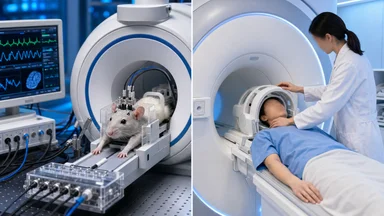
But the borrowing also had costs. Rodent paradigms were optimized for rats, not humans. A tone-shock pairing that works well in a rat chamber may not engage the same cognitive processes in a human lying inside a noisy MRI scanner. Human participants bring language, explicit expectations, and prior learning to the experiment, all of which can modulate fear conditioning in ways that rodent models cannot capture. The twenty-year gap gave rodent findings a reliability edge, but the edge was specific to the conditions under which it was earned.
What Human Fear Studies Gained from Borrowing Rodent Methods
Despite the translation challenges, human fear research gained substantial advantages from borrowing rodent methods. The most important was the availability of well-validated, standardized protocols. Fear-potentiated startle, a measure in which a startling noise elicits a larger eyeblink reflex when the subject is in a fearful state, was developed in rats in the 1970s and adapted to humans in the 1990s. It provided a clean, quantifiable behavioural readout that could be used across species.
Clear behavioural readouts like freezing and startle transferred well to fMRI. A human participant lying in a scanner can be conditioned to a visual cue paired with a mild shock to the wrist, and the resulting amygdala activation can be measured with reasonable reliability. The rodent literature provided computational models of threat learning, such as the Rescorla-Wagner model, which described how prediction errors drive learning. These models were applied to human fMRI data, allowing researchers to track prediction-error signals in the striatum and amygdala.
But human extinction learning—the process by which a conditioned response diminishes when the threat is no longer paired with the cue—shows more individual variation than rodent extinction. Some humans extinguish quickly, others slowly, and some never fully lose the conditioned response. This variation is clinically relevant: it may predict who develops post-traumatic stress disorder after trauma. Rodent models of extinction are more uniform, partly because inbred strains reduce genetic variability. The translation of extinction findings from rodents to humans has been productive but incomplete.
Rodent data also set benchmarks for replication in humans. When a rodent finding about the role of the infralimbic prefrontal cortex in extinction was replicated across multiple labs, it provided a strong prediction for human studies. Human fMRI studies have largely confirmed that ventromedial prefrontal cortex is involved in extinction recall, though the spatial resolution of fMRI makes it difficult to pinpoint the homologous subregion. The rodent data served as a target, not a map.
Counter-Arguments: Could the Rodent Edge Be Overstated?
It is worth considering whether the perceived reliability advantage of rodent fear studies is partly a product of publication bias and methodological differences. Rodent studies, for example, often use inbred strains that reduce genetic variability, which can inflate effect sizes relative to outbred human populations. A finding that holds in a dozen genetically identical rats may not replicate in a diverse human sample. Moreover, rodent behavioural measures like freezing are not exact analogues of human fear; a rat freezing in a chamber may be expressing a different emotional state than a human reporting subjective fear. The translation tax cuts both ways.
Another counter-argument is that human fMRI studies have improved dramatically since the early 2000s. Sample sizes in the typical human fear conditioning study have increased from roughly 15 participants to around 30 or more in recent years, partly due to funding initiatives and partly due to the replication crisis prompting change. Multi-site collaborations, such as the Enhancing Neuro Imaging Genetics through Meta-Analysis (ENIGMA) consortium, now pool data across labs to achieve sample sizes in the hundreds. These efforts are closing the gap, but they are recent—the rodent field had decades to build its evidentiary base.
Some researchers argue that the causal evidence from rodent optogenetics is not as clean as it appears. Optogenetic manipulations can produce off-target effects, and the artificial activation of a neural population may not mimic natural firing patterns. A laser pulse that drives all basolateral amygdala neurons to fire synchronously could produce a behavioural effect that is not representative of normal circuit function. The causal inference is strong, but it is not immune to artefact.
Finally, the human literature has advantages that rodent work cannot match. Human participants can report subjective experience, which provides a richer characterization of fear beyond freezing and startle. Verbal reports of fear intensity, expectancy of shock, and explicit knowledge of contingencies offer insights into conscious processes that rodent models cannot access. The twenty-year grant gap gave rodent research a reliability edge in behavioural readouts, but human research has a unique window into the cognitive and affective dimensions of fear.
Lessons for Translational Neuroscience Funding
The twenty-year grant gap offers lessons for how funding agencies structure support for translational neuroscience. One clear implication is that parallel rodent-human grants could close the inference gap. Instead of funding rodent studies first and human studies later, agencies could require that grants include both species in a coordinated design, with power analyses that ensure adequate sample sizes in each.
Requiring power analyses before human fear studies would reduce the prevalence of underpowered experiments. Journals have begun to mandate such analyses, but funding agencies could go further by rejecting proposals that do not demonstrate sufficient statistical power for the primary hypotheses. Multi-lab consortia, such as the ManyBabies and ManyPrimates projects, offer models for achieving large samples through collaboration. A similar approach for human fear conditioning could produce effect-size estimates that are stable and replicable.
Rodent findings need direct human tests, not analogies. A rodent optogenetics experiment that identifies a causal role for the basolateral amygdala in fear expression should be followed by a human study that tests the same hypothesis using techniques that can measure causal influence, such as transcranial magnetic stimulation or intracranial recordings in epilepsy patients. The twenty-year lag between rodent and human work may have been a hidden blessing for rigor, but it should not be perpetuated.
If anything, the funding asymmetry highlights the value of long-term investment in basic research. The rodent fear conditioning literature, built over decades, provided a foundation that human neuroscience could build upon. The challenge now is to ensure that human research catches up in reliability, not just in volume. Closing the grant gap is one step; closing the inference gap is another.
Future Directions: Bridging the Reliability Gap
Looking ahead, several strategies could help human fear research achieve the reliability that rodent work has long enjoyed. First, pre-registration and registered reports can reduce publication bias and increase confidence in findings. The field of human fear conditioning has seen a rise in pre-registered studies since 2015, but the practice is not yet universal. Second, open data and code sharing allow other labs to verify analyses, which is especially important given the flexibility of fMRI analysis pipelines. Third, the development of human-specific behavioural tasks that capture the richness of fear learning without relying solely on rodent paradigms could improve construct validity. For example, tasks that incorporate instructed fear, observational learning, or verbal threat information may tap into processes that are uniquely human.
Finally, funding agencies should consider supporting longitudinal studies of fear conditioning in humans, tracking individuals over months or years to assess stability and predictive validity. Such studies are expensive but could provide the kind of cumulative evidence that rodent research has produced. The twenty-year grant gap was a historical accident, but it need not define the future. With deliberate effort, human fear research can achieve the reliability that rodent work has long had—while also capitalizing on the unique strengths of human participants.