The Trust Game Participants Who Paid for Rivals’ Reproductions

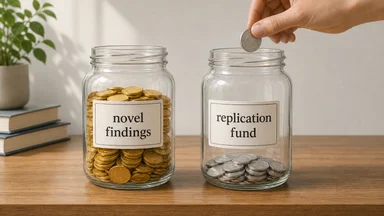
In the standard trust game, one player sends money to another, hoping it will be multiplied and returned. The game is a stripped-down model of cooperation: trust the stranger, or hoard your cash. But a 2025 experiment published in Nature Human Behaviour added a twist. Instead of sending money to a partner, participants could send money to fund a replication of another player's study. And many did—even when that other player was a direct competitor for the same reward pool.
The result offers a window into how scientists might value the slow, unglamorous work of checking each other's results. The experiment was not a survey of stated preferences. It was a game with real money, designed to measure what people actually do when replication carries a personal cost.
Roughly one-third of participants contributed some of their earnings to fund a replication attempt by another player. The replication, if successful, would increase the credibility of the finding—and, in the game's logic, raise the payout for everyone who had invested in that line of work. But it also meant that the participant who funded the replication was helping a rival whose study might outperform their own.
The finding sits at an awkward intersection of behavioral economics and science policy. It suggests that at least some researchers are willing to pay for replication out of their own pockets, even when they have no direct control over the outcome. But it also raises questions about whether that willingness can be scaled up to the institutional level, where replication funding is scarce and often treated as a luxury.
When Paying for Others' Replications Becomes Rational
Trust games have been used for decades to study cooperation, reciprocity, and altruism. In the classic version, two players are anonymous. One receives an endowment and can send any portion to the other. The amount is tripled by the experimenter. The second player then decides how much to send back. The rational self-interested move is to send nothing and keep the endowment. Yet in practice, people send money, and they often return a fair share.
The replication version adapted this setup to mimic the dynamics of scientific competition. Participants were assigned a hypothetical research finding and could earn money by producing results that were novel and statistically significant. But they also had the option to spend some of their earnings to commission a replication of another participant's finding. The replicator—a separate player—would attempt to reproduce the original result. If successful, the original finding's value increased for everyone who had invested in it.
This design captures a tension at the heart of science: individual researchers benefit from being first with a novel result, but the community as a whole benefits from knowing which results are robust. The game's payoffs were structured so that funding a replication was never individually profitable in the short term. It only made sense if a participant cared about the collective credibility of the research enterprise.
And yet participants did fund replications. The average contribution was about 15 percent of a participant's earnings, with some contributing as much as half. The behavior was not confined to a few altruistic outliers. It was widespread enough to shift the overall distribution of payoffs in the game.
One interpretation is that the participants—mostly university students and early-career researchers—internalized a norm of scientific self-correction. They saw replication not as a threat to their own work but as a public good that everyone, including themselves, would benefit from. That is a strikingly cooperative stance in a setting designed to pit individual incentives against collective ones.
The Experiment: Designing a Market for Replication
The experiment was run by a team of behavioral economists and social psychologists at a large European university. They recruited 240 participants across four sessions, each lasting about two hours. The stakes were real: participants earned an average of €35, with a range from €10 to €60, depending on their choices and the outcomes of the replication attempts.
In the first phase, each participant generated a research finding by choosing a hypothesis from a set of plausible options and then running a simulated experiment. The results were noisy—sometimes significant, sometimes not—but participants earned money based on the novelty and statistical significance of their finding. This phase was designed to create a sense of ownership and investment in the result.
In the second phase, participants were randomly paired and given the option to spend some of their earnings to fund a replication of their partner's finding. The replicator was a third player who had no stake in either finding and would receive a fixed fee for conducting the replication. The replication attempt had a known statistical power: 80 percent chance of detecting a true effect of a given size. If the replication succeeded, both the original researcher and any funders received a bonus.
The design was inspired by public-goods games, where individuals can contribute to a common pool that benefits everyone, even those who do not contribute. In this case, the common pool was the credibility of the research output. A successful replication raised the value of the original finding for everyone who had invested in it, but the funder bore the full cost.
Critically, participants could choose to fund a replication of a rival's finding—someone whose result might be more novel or more lucrative than their own. The game thus captured a central dilemma of science: you might want your own work to be replicated, but you might also want to check a competitor's work, especially if you suspect it is shaky. The experiment allowed both motives to operate.
What the Data Showed About Who Pays and Why
The headline result is that about 34 percent of participants contributed at least some money to fund a replication of their partner's finding. Among those who contributed, the average amount was €4.20, roughly 15 percent of their earnings. But the distribution was skewed: a small number of participants contributed large sums, while the majority contributed nothing.
Who were the contributors? The data suggest two main profiles. First, participants who earned more in the initial phase were more likely to contribute. This is consistent with a wealth effect: having more money makes it easier to spend on a public good. But it also hints at a sense of obligation. High earners may have felt that their success came partly from the community's trust in the research process, and they wanted to pay that trust forward.
Second, participants who expressed stronger belief in the importance of replication—measured in a post-game questionnaire—were more likely to contribute. This correlation held even after controlling for earnings, gender, and academic discipline. It suggests that the decision to fund replication was not just a matter of spare cash but was tied to a genuine valuation of replication as a scientific practice.
Interestingly, there was no significant correlation between a participant's own replication history—whether their own finding had been replicated in a previous round—and their willingness to fund others. That is, people did not simply reciprocate. They funded replication even when they had no expectation of receiving the same treatment.
The researchers also tested for strategic motives. Could participants be funding replication to signal their own trustworthiness, hoping to attract funding from others? To control for this, they ran a version of the game where funding decisions were anonymous and could not be traced back to the funder. Even under anonymity, contributions remained substantial, though slightly lower. This suggests that pure altruism or a sense of scientific duty played a role, beyond any strategic signaling.
The Methodological Tightrope: Incentives vs. Altruism
The experiment is clever, but it is also a lab game. Critics might argue that the stakes were too low to mimic real scientific funding decisions. A €4 contribution is trivial compared to the tens of thousands of dollars a researcher might spend on a replication study. The participants were not making decisions under the same pressures as principal investigators managing grant budgets.
Moreover, the game simplified the replication process in ways that might matter. In reality, replication attempts are messy, time-consuming, and often inconclusive. The game assumed a fixed statistical power and a binary outcome: success or failure. Real replications can yield ambiguous results, require multiple attempts, and involve disagreements over interpretation. The clean payoff structure of the game may have made replication seem more attractive than it is in practice.
The researchers acknowledge these limitations. In their paper, they describe the experiment as a "proof of concept" that the willingness to fund replication exists, not as a direct prediction of real-world behavior. They also note that the participants were mostly students and early-career researchers, who may be more idealistic about science than established investigators.
Still, the fact that contributions persisted under anonymity is telling. It suggests that the motive is not just about reputation or reciprocity but reflects an intrinsic valuation of replication as a public good. This is consistent with survey data showing that a majority of researchers believe replication is important but that the incentive structure of science does not reward it.
The experiment also raises a subtle question: is funding a rival's replication a form of cooperation or a form of monitoring? In the game, funding a replication could be seen as a way to keep a competitor honest. If you suspect their result is too good to be true, paying for a replication is a way to check. That motive is not entirely altruistic. It is a blend of self-interest and collective interest—exactly the kind of mixed motive that drives many real-world scientific practices, such as peer review.
What This Means for the Replication Crisis Conversation
The replication crisis in psychology, and to a lesser extent in other fields, has been framed as a failure of incentives. Researchers are rewarded for publishing novel, positive results, not for checking whether those results hold up. Replication studies are hard to publish, hard to fund, and hard to get credit for. The crisis has prompted calls for structural reforms, such as preregistration, registered reports, and replication grants.
The trust-game experiment adds a new dimension to this conversation. It suggests that the problem may not be that researchers do not value replication. The problem may be that the funding system does not allow them to act on that value. If researchers are willing to spend their own money—in a game, at least—to fund replication, then perhaps the bottleneck is not demand but supply.
This shifts the focus from blaming individual researchers for not doing enough replication to asking why the infrastructure for replication is so weak. If a substantial fraction of researchers would voluntarily contribute to a replication fund, maybe institutions should create such funds and match contributions. The experiment provides a behavioral rationale for policies that lower the cost of funding replication.
It also suggests that replication might be more sustainable if it were treated as a collective good rather than an individual duty. The game's structure is analogous to a crowdfunding platform for replication, where researchers pool resources to check each other's work. Such platforms exist in nascent form—for example, the Replication Markets project at the University of Innsbruck, which allows researchers to bet on the outcome of replication attempts. But they have not yet been widely adopted.
Of course, lab behavior may not scale. The participants in the game were making small, one-time decisions. Real researchers face repeated interactions, career pressures, and institutional constraints. A field experiment where researchers could allocate a portion of their grant money to a replication pool would be a more rigorous test. The trust-game results suggest such a test is worth running.
Practical Takeaways for Research Funders and Journals
If the finding holds up—and it should be replicated, naturally—it has concrete implications for how science is organized. Funding agencies could create matching programs where every dollar a researcher contributes to a replication pool is matched by the agency, effectively doubling the impact. This would leverage the willingness to contribute that the experiment revealed.
Journals could also play a role. Some already offer badges for replication studies, but they could go further by allowing authors to allocate a portion of their article processing charges to a replication fund. This would create a direct link between publishing novel results and funding their verification.
Preregistration of replication attempts could be incentivized by making them eligible for rapid review and publication. If journals committed to publishing a certain number of replication studies per year, researchers would have a clearer target for their contributions. The experiment suggests that the demand side is not the problem; it is the supply of venues and funding.
But there are risks. Creating a separate funding stream for replication could be seen as a tax on novel research, reducing the overall resources available for discovery. And if replication funding is tied to individual contributions, it might exacerbate inequalities: well-funded labs could afford to contribute more, giving them more influence over what gets replicated.
The experiment also does not address the question of which findings should be replicated. In the game, participants could only fund replication of their partner's finding, not any finding they chose. Scaling up would require a mechanism for prioritizing replications—perhaps based on the importance of the finding, the strength of the original evidence, or the degree of controversy.
Another limitation is that the game did not allow participants to replicate their own findings. In reality, researchers often attempt to replicate their own work before publishing, but this self-replication is not captured in the experiment. The game's design focused on funding others' replications, which may overestimate altruistic motives. A more complete model would include the option to self-fund replication, which might be more common in practice.
Furthermore, the experiment did not explore the possibility of fraud or error. In the game, all findings were generated honestly, but in real science, some results may be fabricated or contain unintentional errors. The willingness to fund replication might change if participants suspected malfeasance. Future studies could introduce a condition where some findings are known to be unreliable, to see if that affects contribution rates.
For now, the trust-game results are a provocative data point. They suggest that the scientific community may be more willing to pay for replication than the current funding system assumes. But the gap between a lab game and actual research practice remains wide. The next step is to test whether this willingness survives in the wild, where the stakes are higher and the outcomes are less certain.