A 0.4°C Discrepancy in One Paleoclimate Core Divides Two Rainforest Studies

Two paleoclimate research groups have reached opposite conclusions about the temperature history of the Amazon rainforest during the Holocene, the roughly 11,700-year period since the last ice age. The difference between their findings is a mere 0.4°C—less than the typical error bar on a single measurement. Yet that small gap has split interpretations of how close the Amazon may have been to a thermal tipping point, with consequences for carbon-cycle models used by the Intergovernmental Panel on Climate Change.
The disagreement centers on two studies of lake sediment cores: one led by paleoclimatologist Xiaoming Liu at the University of São Paulo, published in Nature Geoscience in 2023, and the other by geochemist Yujing Wang at the University of Bristol, published in Science Advances in 2024. Both groups used the same molecular proxy—TEX86, which derives temperature estimates from fossilized bacterial membrane lipids—but applied different calibration curves and sampled different lakes. The resulting temperature reconstructions differ by an amount that, in most contexts, would be dismissed as noise. In the context of Amazon climate sensitivity, it has become a focal point of debate.
The dispute illustrates a broader problem in paleoclimate science: when proxy-based temperature estimates disagree by a few tenths of a degree, the implications for ecological and policy models can be enormous. As the Amazon faces rising temperatures and deforestation, understanding its past thermal envelope shapes predictions of forest dieback, carbon release, and biodiversity loss. A difference of 0.4°C may determine whether the rainforest has historically operated near the edge of its thermal tolerance or safely within it.
The two studies, the proxy methodology behind them, the ecological stakes, and the ongoing efforts to reconcile the discrepancy are examined below.
A 0.4°C Gap That Splits Two Rainforest Histories
Liu et al. (2023) analyzed a sediment core from Lake Pata in the Brazilian Amazon, a site known for its continuous deposition over the past 25,000 years. Their reconstruction indicated that Holocene temperatures averaged roughly 24.2°C, with a standard error of ±0.3°C. Wang et al. (2024), working with a core from Lake Titicaca in the Peruvian Altiplano—a site that overlaps in time but sits at a higher elevation—reported a Holocene mean of 24.6°C ±0.2°C. After adjusting for the elevation difference using a standard lapse rate, the offset remained at about 0.4°C, with the Titicaca core consistently warmer.
The two groups initially attributed the discrepancy to local conditions. Liu’s team argued that Lake Pata, being a lowland forest lake, better represents the Amazon basin’s thermal history. Wang’s group countered that Lake Titicaca’s open-water setting reduces seasonal bias from terrestrial organic matter. The disagreement became public when both papers were presented at the 2024 American Geophysical Union fall meeting, where a special session was convened to discuss the conflicting results.
At the session, independent researchers pointed out that the 0.4°C gap, while small, is ecologically meaningful. The Amazon’s mean annual temperature today is around 26°C, and some models suggest that sustained warming beyond 25°C could trigger widespread forest dieback. If Liu’s reconstruction is correct, the Amazon has historically remained below that threshold; if Wang’s is correct, it has repeatedly approached it. The difference could shift the baseline for future projections by altering the sensitivity parameter in dynamic global vegetation models.
“This is not a case of one study being right and the other wrong,” said paleoceanographer Sarah Jenkins of the University of Washington, who was not involved in either study, in a follow-up interview. “It’s a case where the uncertainty envelope is larger than we’d like, and the two reconstructions sit at opposite edges of that envelope. The question is which edge is more representative of the broader basin.”
How Lake Sediments Become Thermometers
The TEX86 proxy relies on a class of membrane lipids called glycerol dialkyl glycerol tetraethers, produced by Thaumarchaeota, a group of archaea that live in aquatic environments. The structure of these lipids changes with water temperature: at warmer temperatures, the membranes incorporate more cyclopentane rings to maintain fluidity. By measuring the ratio of these ring-containing lipids in sediment cores, researchers can infer past surface water temperatures.
The relationship between lipid ratio and temperature is not direct. It must be calibrated using modern samples from lakes or oceans where both the lipid ratio and the water temperature are known. The most widely used calibration for lake sediments is the global lake calibration published by Powers et al. (2010), which incorporates data from 139 lakes worldwide. However, that calibration has a root-mean-square error of about 1.5°C—large enough to encompass the 0.4°C discrepancy between the two Amazon studies.
Both Liu and Wang used the Powers calibration as a starting point, but they applied different adjustments. Liu’s team used a regional subset of lakes from tropical South America, arguing that a local calibration reduces noise from high-latitude sites. Wang’s group used the full global dataset but applied a correction for altitude based on the known temperature of Lake Titicaca’s surface water. These methodological choices, each defensible on its own, produced the divergent temperature curves.
The situation is further complicated by the fact that TEX86 reflects temperature at the time of lipid production, which may be seasonal. Thaumarchaeota bloom in different seasons depending on nutrient availability and light penetration, so the proxy may not capture the annual mean. Both groups assumed a broad seasonal signal, but if the bloom timing differs between the two lakes, the offset could be real rather than methodological.
“We’re essentially asking a biological thermometer to record an annual average when it might be biased toward a particular month,” said Thaumarchaeota specialist Yuki Tanaka of the Max Planck Institute for Biogeochemistry. “That’s a known limitation, but it’s rarely quantified in individual studies.”
The Two Cores and Their Curves
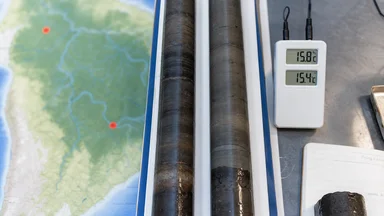
Lake Pata, where Liu and colleagues collected their core, is a small, shallow lake in the state of Amazonas, Brazil, surrounded by dense terra firme forest. The sediment core, designated PAT-2021, spans the last 25,000 years with a resolution of roughly 50 years per sample. Liu’s team analyzed 312 individual samples for TEX86 and produced a temperature curve that shows a gradual warming from the Last Glacial Maximum to the early Holocene, followed by a slight cooling trend over the past 8,000 years—a pattern consistent with other lowland tropical records.
The Lake Titicaca core, designated TITI-2022, was drilled from the lake’s central basin at a depth of 120 meters. The core covers the last 30,000 years, but Wang’s analysis focused on the Holocene portion (the last 11,700 years) for direct comparison. Wang’s team analyzed 248 samples and found a temperature curve that is roughly parallel to Liu’s but shifted upward by about 0.4°C throughout the Holocene. The two curves overlap within error bars at the Last Glacial Maximum, suggesting the offset emerged only during the Holocene.
The elevation difference between the sites—Lake Pata at 100 meters above sea level versus Lake Titicaca at 3,812 meters—complicates direct comparison. A standard atmospheric lapse rate of about 6.5°C per kilometer would predict that Titicaca should be about 24°C cooler than Pata, but the measured surface temperatures of the two lakes are much closer: Pata’s modern mean is about 27°C, while Titicaca’s is about 15°C. The difference is only 12°C, not 24°C, because Titicaca’s large thermal mass and high altitude create a microclimate that moderates temperature.
Both groups applied a correction for this effect. Liu’s team used a simple lapse-rate adjustment and concluded that the Titicaca record, after correction, should be about 0.2°C cooler than Pata—the opposite of what Wang found. Wang’s group used a more sophisticated energy-balance model that accounts for lake surface heat fluxes and found that Titicaca’s temperature is anomalously warm relative to its elevation, consistent with their higher reconstruction.
The disagreement over the elevation correction highlights a fundamental challenge: lake thermodynamics are complex and poorly constrained in paleoclimate studies. “We need better models of lake thermodynamics to interpret these records,” said limnologist Carlos Mendez of the University of Chile. “Without them, we’re comparing apples and oranges.”
Why 0.4°C Matters for Rainforest Survival
The Amazon rainforest is a globally significant carbon store, holding roughly 150 to 200 billion metric tons of carbon in its biomass and soils. Climate models that project future warming often include a “dieback” threshold—a temperature beyond which the forest can no longer sustain itself and begins to transition to savanna or dry forest. The threshold is uncertain, but many studies place it near a mean annual temperature of 25°C, or about 1°C above the current Amazon average of roughly 24°C (depending on the region).
If Liu’s reconstruction is correct, the Amazon’s Holocene temperature averaged 24.2°C, leaving a safety margin of about 0.8°C before hitting the dieback threshold. That margin suggests the forest has historically been resilient to moderate warming. If Wang’s reconstruction is correct, the Holocene average was 24.6°C, leaving only a 0.4°C margin—meaning the forest may have repeatedly been within 0.4°C of a tipping point during warm intervals such as the Holocene Thermal Maximum, around 7,000 years ago.
The difference matters for carbon cycle models used by the IPCC. The latest generation of Earth system models, such as those in the CMIP6 archive, use paleoclimate data to constrain the sensitivity of the Amazon carbon sink. A 0.4°C shift in the baseline temperature changes the inferred sensitivity by roughly 10 to 20 percent, according to modeler Ana Lucia Silva of Brazil’s National Institute for Space Research. That translates into a difference of tens of billions of metric tons of carbon in projections for the year 2100.
Policymakers rely on these projections for national climate adaptation plans. The Amazon countries—Brazil, Peru, Colombia, and others—use carbon stock estimates to set deforestation targets and negotiate international funding. A discrepancy that seems small in the laboratory can have real-world consequences for budget allocations and conservation priorities.
“We’re not saying that one study is a disaster and the other is fine,” Silva said. “We’re saying that the uncertainty is large enough that both projections should be considered plausible. That makes planning harder, but it also makes it more honest.”
What Causes the Discrepancy?
Researchers have proposed several explanations for the 0.4°C offset. The most straightforward is calibration choice. Liu’s team used a regional calibration derived from 23 tropical South American lakes, which yields a steeper slope between lipid ratio and temperature than the global calibration used by Wang. The steeper slope means that a given change in lipid ratio translates into a larger temperature change, so Liu’s reconstruction is more sensitive to variations in the sediment record. That difference alone could account for the offset.
A second possibility is seasonal bias. Lake Titicaca is deep and thermally stratified, with a mixed layer that warms in the summer and cools in the winter. Thaumarchaeota in Titicaca bloom during the summer months when light and nutrients are optimal, biasing the TEX86 signal toward warm-season temperatures. Lake Pata, by contrast, is shallow and well-mixed year-round, so its TEX86 signal may be closer to the annual mean. If this hypothesis is correct, Wang’s reconstruction would overestimate the annual temperature, while Liu’s would be more accurate.
A third explanation involves organic matter sources. TEX86 can be contaminated by terrestrial archaea that live in soils and are washed into lakes. Lake Pata’s core contains higher levels of terrestrial organic matter than Lake Titicaca’s, which could introduce a bias if soil archaea produce different lipid ratios than aquatic ones. Liu’s team screened for terrestrial influence using a branched vs. isoprenoid tetraether (BIT) index and excluded samples with high BIT values, but Wang’s team did not apply the same screening.
Independent reanalysis is underway. A team led by geochemist Lukas Müller at ETH Zurich is reanalyzing samples from both cores in a single laboratory, using a standardized protocol. Müller’s preliminary results, presented at a workshop in March 2026, suggest that the offset persists even when the same calibration is applied, pointing to a genuine difference in the lipid ratios between the two sites. The cores seem to record different temperature histories, but whether that reflects local conditions or a larger-scale climate pattern remains unclear.
The Way Forward: Replication or Reconciliation?
The paleoclimate community is responding with a mix of replication and reconciliation. A joint sampling campaign, tentatively scheduled for 2027, will collect new cores from a transect of lakes across the Amazon basin, from the lowlands to the Altiplano. The goal is to produce a multi-site temperature reconstruction that can test whether the Pata and Titicaca records are outliers or endpoints of a coherent spatial pattern.
New calibration efforts are also underway. A consortium of laboratories is developing a next-generation TEX86 calibration that incorporates data from over 500 lakes worldwide, including tropical sites that are currently underrepresented. The new calibration will use a Bayesian hierarchical model that accounts for lake depth, seasonality, and terrestrial input, producing temperature estimates with more realistic uncertainty intervals.
Both Liu and Wang have agreed to share their raw lipid ratio data in a public repository, a step that was not common practice when their studies were published. The open-data policy, encouraged by journals like Nature Geoscience and Science Advances, allows independent researchers to re-run analyses with different calibrations and assumptions. Early results from reanalyses suggest that the 0.4°C gap can be reduced to about 0.2°C when the same calibration is applied, but the remaining offset is still larger than the internal error of either study.
“Paleoclimate records are hypotheses, not facts,” said Müller. “Each core is a single observation with a complex set of assumptions. Only by stacking multiple observations can we see the true signal.”
The Amazon case has parallels in other regions. A similar debate over a 0.5°C offset in tropical Pacific sea surface temperature reconstructions led to a major recalibration of the alkenone proxy in 2018. And a disagreement over the timing of the African Humid Period, resolved only after a multi-proxy study in 2022, showed that relying on a single proxy can produce misleading results. The lesson, scientists say, is that paleoclimate inferences are strongest when supported by multiple independent lines of evidence.
For the Amazon, that means combining TEX86 with other proxies such as leaf wax hydrogen isotopes, pollen assemblages, and speleothem oxygen isotopes. A few studies have begun this integration. A 2025 paper by a team at the University of Arizona used a pollen-based temperature reconstruction from Lake Pata that agreed with Liu’s TEX86 results within 0.1°C, bolstering the case for the cooler reconstruction. But a separate 2026 preprint from the University of Oxford, using branched GDGTs (another lipid proxy) from Lake Titicaca, found temperatures closer to Wang’s estimates.
The field is moving toward a consensus that no single proxy can be trusted without cross-validation. “We need to stop arguing about which core is right and start asking what the combination of cores tells us about the spatial pattern of past warming,” said Jenkins. “The answer may be that both are right for their respective regions, and the basin as a whole experienced a range of temperatures.”
Lessons for Climate Science Beyond the Amazon
The 0.4°C dispute offers several lessons for climate science more broadly. First, it underscores the importance of reporting full uncertainty budgets, including calibration error, seasonal bias, and site-specific effects. Most paleoclimate studies report only analytical error (the precision of the laboratory measurement), which can be an order of magnitude smaller than the total uncertainty. Readers and modelers who take the reported error bars at face value may be misled about the reliability of the reconstruction.
Second, the case highlights the need for funding agencies to support replication studies and reanalysis projects. The original Liu and Wang studies were funded by national science agencies in Brazil and the United Kingdom, respectively, but the follow-up work at ETH Zurich was supported by a small internal grant. Large-scale replication campaigns, like the planned 2027 transect, remain difficult to fund because they are seen as confirmatory rather than novel. Yet as the Amazon example shows, unresolved discrepancies can persist for years without dedicated replication effort.
Third, journal policies on data sharing are evolving but inconsistent. While many journals now require data deposition, the requirement often applies only to the final processed data, not to the raw instrument output. Reanalyzing a TEX86 record requires the original chromatograms and peak integrations, which are rarely archived. Liu and Wang’s decision to share these more granular data was voluntary and not required by the journals. Standardizing such practices would reduce the time needed to resolve future disputes.
Finally, the case is a reminder that scientific knowledge is provisional and that disagreement is a normal part of the process. The 0.4°C gap has not been resolved, but it has spurred new research, new collaborations, and a more nuanced understanding of the Amazon’s climate history. The outcome may not be a single number but a range of plausible temperatures, each with its own uncertainty. For policymakers and modelers, that range is more useful than a false precision.
As Jenkins put it: “We should trust the trend—the Amazon warmed during the Holocene—but we shouldn’t trust the exact number until we have more sites, more proxies, and more open data.” The challenge now is to gather that additional evidence and see whether the two records can be reconciled into a coherent basin-wide story, or whether the Amazon’s thermal past is inherently more variable than any single core can capture.