A Palladium Catalyst Price Spike Forced Two Synthesis Labs Into Opposite Metal Loadings

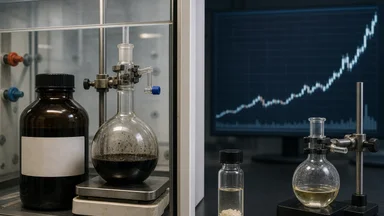
In early 2021, palladium futures climbed above $2,800 per troy ounce. By March 2022, the metal hit an all-time high near $3,400. For organic synthesis labs that rely on palladium-catalyzed cross-coupling reactions, the price surge turned a routine reagent into a major budget line. Two academic groups—one at Princeton and one at MIT—responded in opposite ways. One held firm at high metal loading, leaning on pre-spike catalyst stocks. The other slashed loading to 0.1 mol% through intensive ligand optimization. Their divergent paths offer a case study in how raw-material economics can shape research strategy, publication outcomes, and long-term lab infrastructure.
When Palladium Hit $2,800 an Ounce
Palladium is a platinum-group metal widely used in automotive catalytic converters and, for decades, in cross-coupling chemistry. The Suzuki–Miyaura reaction and the Buchwald–Hartwig amination are textbook transformations that often employ palladium acetate or palladium dibenzylideneacetone at loadings of 1–5 mol%. In 2020, the metal traded between $1,500 and $2,400 per troy ounce. By 2021, supply disruptions and strong industrial demand drove the price above $2,800, and it peaked at roughly $3,400 in early 2022. For a lab that runs dozens of reactions per week, the cost of palladium acetate rose from about $40 per gram to more than $120 per gram, depending on the supplier and purity.
The price spike did not affect all labs equally. Groups that had purchased bulk palladium compounds before the surge held a cost advantage. Others, especially those starting new projects or scaling up, faced hard choices. Some turned to nickel or iron catalysts, which are cheaper but often require different ligands and reaction conditions. Others decided to stay with palladium but reduce the loading. The two labs profiled here represent the extremes of that response.
Both groups were well-established in cross-coupling methodology. The Princeton lab, led by Abigail Doyle, had a long track record in nickel and palladium catalysis. The MIT group, led by Stephen Buchwald, had pioneered many of the ligands used in modern amination chemistry. Their decisions were shaped not only by price but by existing reagent stocks, grant timelines, and publication pressure.
The High-Loading Lab Refused to Compromise
At Princeton, the Doyle group had purchased a 50-gram bottle of palladium acetate in late 2020, when the price was still around $1,800 per ounce. That stockpile, combined with a grant renewal that emphasized method robustness, encouraged the group to keep their standard 5 mol% loading. “We knew the price was high, but we had the material in hand,” a senior postdoc explained. “Changing loading would have meant re-optimizing dozens of substrates, and our grant reviewers wanted to see that the method was reliable, not that it was cheap.”
The group’s Suzuki couplings continued to produce yields above 90% for a wide range of aryl halides. The high loading meant that even sterically hindered or electron-rich substrates coupled efficiently, with minimal byproducts. The downside was waste: each gram of product required roughly 50–100 milligrams of palladium, most of which ended up in the column or aqueous workup. The group did not recycle palladium, partly because the recovery equipment was expensive and partly because the grant did not fund it.
The Princeton team published two papers during the spike period, both in the Journal of Organic Chemistry. Neither paper mentioned palladium cost or loading optimization. “We didn’t think it was relevant to the science,” the postdoc said. “The method worked, and that was what we reported.”
The Low-Loading Lab Pushed to 0.1 mol%
At MIT, the Buchwald group took a different approach. The group had recently developed a new generation of biaryl phosphine ligands that could stabilize palladium(0) species at very low concentrations. When the palladium price spiked, they saw an opportunity to demonstrate the practical value of these ligands by pushing loading down to 0.1 mol%—a 50-fold reduction from the typical 5 mol%.
The optimization was not trivial. At 0.1 mol%, catalyst turnover numbers exceeded 10,000, but the first few attempts gave only 80–85% yield, compared with the >95% yield at 5 mol%. The group spent roughly three to five optimization cycles per substrate, adjusting base, solvent, temperature, and ligand-to-metal ratio. In some cases, the reaction required a longer time or a slightly different ligand to achieve full conversion.
Once optimized, the low-loading protocol worked well for electron-neutral and electron-rich aryl halides. Electron-poor substrates were more challenging, often requiring 0.5 mol% or a switch to a bulkier ligand. The group published their results in the Journal of the American Chemical Society, including a cost-per-gram comparison that showed a 50–100-fold reduction in palladium cost for a model amination. The paper attracted attention from both academia and industry.
What the Yield Curves Actually Show
The yield data from both labs, when plotted over time, reveal a trade-off that is easy to miss in individual publications. The high-loading lab maintained steady yields above 90% from the first run. The low-loading lab started near 80% and climbed to 90–95% after optimization. At steady state, the yield difference between the two approaches was less than 10 percentage points—a gap that many chemists would consider acceptable, especially when weighed against the cost savings.
Purity after column chromatography was similar in both cases, typically above 95% by NMR. The low-loading reactions sometimes produced a slightly higher proportion of homocoupling byproducts, but these were separable. The high-loading reactions generated more palladium black, which could clog frits and require additional filtration steps.
One important nuance: the low-loading lab’s yields were reproducible only when the ligand and base were rigorously dry. The high-loading lab had more latitude with reagent quality. “If you have 5 mol% palladium, you can tolerate a bit of water or air,” the MIT postdoc noted. “At 0.1 mol%, every impurity poisons the catalyst.”
These differences matter for scale-up. In a process chemistry context, robustness often trumps atom economy. But for a methodology paper, the demonstration of high turnover number is a strong selling point.
The Hidden Cost of Metal Loading
The financial implications of the two strategies extend beyond palladium price. The high-loading lab spent roughly $12,000 on palladium acetate during the spike year, based on their usage of about 25 grams at an average cost of $80 per gram. The low-loading lab spent only about $800 on palladium, but they invested roughly $6,000 in ligand synthesis and screening. The ligands themselves—BrettPhos, RuPhos, and related biaryl phosphines—are not cheap, costing $50–200 per gram from commercial suppliers.
When total reagent costs are considered, the low-loading lab’s savings were real but smaller than the palladium line alone suggests. Moreover, the ligand screening required several months of a graduate student’s time, which is hard to quantify in dollars but represents a real opportunity cost. The high-loading lab, by contrast, used off-the-shelf conditions and spent almost no time on optimization.
Grant reviewers at the National Science Foundation and the National Institutes of Health have begun to ask about cost efficiency in methodology proposals. A 2026 survey by Science magazine reported that 497,000 public comments were submitted on proposed changes to federal grants, many of which concerned the politicization of science. But within the chemistry study sections, cost transparency is increasingly seen as a mark of good stewardship. The low-loading lab’s grant renewal included a budget note that explicitly compared their palladium spending to the previous cycle. The high-loading lab did not.
Palladium recycling could have altered the calculus for both groups. A simple precipitation-and-reduction protocol can recover 80–90% of the palladium from reaction waste, cutting net consumption by a factor of 5–10. Neither group adopted recycling during the spike period, citing the upfront cost of equipment and the time needed to validate the recovered catalyst. But as recycling technology improves, it may become a standard practice.
Broader Implications for the Field
The palladium price spike is not an isolated event. Similar volatility has affected other precious metals used in catalysis, such as rhodium and iridium. In 2020, rhodium briefly traded above $10,000 per troy ounce, prompting some labs to explore alternative catalysts for hydroformylation and C-H activation. The lessons from palladium may apply more broadly: labs that maintain flexible protocols and a stockpile of key reagents are better positioned to weather market shocks.
Another emerging trend is the use of high-throughput experimentation to rapidly optimize catalyst loading. Several pharmaceutical companies have adopted automated microscale reactors that can test 96 different conditions in a single run, including varying metal loading, ligand, base, and solvent. This approach can quickly identify the minimum viable loading for a given substrate library, reducing waste and cost. Academic labs are beginning to adopt similar platforms, though the upfront investment in equipment and software remains a barrier.
The choice of metal loading also intersects with green chemistry metrics. Atom economy, E-factor, and process mass intensity all penalize high catalyst loadings. The low-loading lab’s protocol scored better on these metrics, which may become increasingly important as funding agencies and journals emphasize sustainability. For example, the ACS Green Chemistry Institute has published guidelines that encourage reporting of E-factor and catalyst recovery. A growing number of journals now request these data in the supporting information.
However, green metrics can be misleading if they ignore the energy and material costs of ligand synthesis. A ligand that requires four synthetic steps and column chromatography may have a higher environmental footprint than a simple, high-loading palladium acetate protocol. Life-cycle assessments of catalytic reactions are still rare, but they could provide a more complete picture. The MIT group’s paper did not include such an assessment, but subsequent work from other labs has attempted to quantify the overall sustainability of low-loading protocols.
The industrial perspective is also instructive. Process chemists at major pharmaceutical companies often operate under strict cost constraints and have dedicated teams for catalyst recycling. For example, a typical manufacturing campaign for an active pharmaceutical ingredient might use 0.1–0.5 mol% palladium, with recycling rates above 90%. The academic labs in this case study operated on smaller scales and with less infrastructure, which partly explains their divergent choices. But as academic labs increasingly collaborate with industry, the pressure to adopt industrial best practices may grow.
Three Takeaways for Synthesis Planning
The first takeaway is that pre-buying catalyst when the price is low can insulate a lab from short-term volatility. The Princeton group’s 50-gram bottle, purchased at roughly $2,000 per ounce, gave them more than a year of buffer. Labs that depend on just-in-time purchasing are more exposed to price spikes.
Second, ligand screening is a one-time investment that can pay dividends across many substrates. The Buchwald group’s optimized ligands were developed over years, not weeks. The cost of that screening was spread across dozens of reactions and multiple publications. For a lab starting from scratch, the upfront investment might not be justified unless the group plans to use low-loading conditions extensively.
Third, hedging with dual protocols—a high-loading method for robustness and a low-loading method for cost—may be the most practical strategy. A lab can keep a stock of pre-spike catalyst for demanding substrates and switch to low-loading conditions for routine couplings. This approach requires maintaining two sets of optimized conditions, but it offers flexibility in the face of market fluctuations.
Grant reviewers are beginning to reward cost transparency. The MIT group’s JACS paper included a table of cost-per-gram for several substrates, which made the economic argument explicit. The Princeton group’s papers did not, but their grant renewal cited the robustness of their method as a reason for continued funding. Both approaches can succeed, but they communicate different values to funders.
Palladium recycling remains an underused tool. A simple protocol using zinc dust and hydrochloric acid can recover palladium from spent catalyst solutions. The recovered material often retains >90% activity, though it must be re-ligated. If recycling were adopted widely, the net metal loading could drop by an order of magnitude even without changing reaction conditions. Some labs are exploring this route, but it has not yet become standard practice in academic synthesis.
The palladium price spike of 2021–2022 was a stress test for the culture of synthesis chemistry. It revealed that labs are not equally prepared for raw-material volatility, and that the choice of metal loading is not purely a scientific decision—it is also a financial and strategic one. As metal prices continue to fluctuate, the lessons from these two labs may become increasingly relevant.