A Microwave Receiver Price Threshold Divided Two Fast Radio Burst Catalogues

In 2007, astronomers stumbled upon a new class of cosmic signal: fast radio bursts (FRBs), millisecond-long flashes of radio energy from distant galaxies. For years, only a handful were known, and each detection was a major event. Then came CHIME, a telescope built from spare parts and consumer electronics, and suddenly FRBs became almost routine. The Canadian Hydrogen Intensity Mapping Experiment (CHIME) now detects tens of bursts per day, while the Australian Square Kilometre Array Pathfinder (ASKAP), a far more expensive instrument, catches only a few bright events. The discrepancy between the two catalogues—roughly a factor of ten in detection rate per unit sky area—has become a central puzzle in FRB science. It turns out the answer may lie not in the physics of the bursts, but in the economics of the receivers.
The Two Catalogues That Should Agree but Do Not
CHIME's first FRB catalogue, released in 2021, contained over 500 bursts. The second catalogue, published in 2023, expanded that to thousands. ASKAP's catalogue, by contrast, numbers in the dozens—perhaps a hundred when including follow-up observations. Both telescopes operate at similar radio frequencies, around 400–800 MHz for CHIME and 700–1800 MHz for ASKAP. Both are located in radio-quiet zones. Yet the disparity in detection rates is stark: CHIME sees roughly one FRB per square degree per day, while ASKAP sees about one per ten square degrees per day.
At first, astronomers assumed the difference was due to sensitivity. ASKAP's dishes are larger—each 12 metres in diameter—and its receivers are more sophisticated. But sensitivity alone cannot explain the gap. When corrected for the narrower field of view and higher frequency range of ASKAP, the predicted rate should still be higher than observed. Something else is suppressing ASKAP's yield.
Part of the answer lies in the bursts themselves. CHIME detects fainter, more numerous events, while ASKAP sees only the brightest. But that just pushes the question back: why does one telescope see faint bursts and the other does not? The resolution is insufficient to explain the missing population. Both telescopes can localise bursts to within arcminutes, enough for cross-identification. The tension frustrates population models, which must account for a steep luminosity function and a possible redshift evolution that neither catalogue alone can constrain.
The disagreement has real consequences. Models of FRB progenitor populations—whether neutron stars, magnetars, or something more exotic—rely on the observed rate and brightness distribution. If the true rate is closer to CHIME's, then FRBs are common enough to be a significant cosmological tool for mapping the intergalactic medium. If it is closer to ASKAP's, then they are rarer and less useful. The field has been stuck between two catalogues that should agree but do not.
Consider a specific comparison: the CHIME catalogue includes bursts with fluences as low as a few Jy·ms, while ASKAP's typical detection threshold is an order of magnitude higher. This difference in sensitivity explains part of the rate gap, but not all. Even when the fluence distributions are matched, CHIME still finds more bursts per unit sky area. The extra factor must come from the survey strategy—CHIME's continuous monitoring versus ASKAP's targeted, time-constrained observations. ASKAP typically observes a given field for only a few hours per year, while CHIME stares at the same patch of sky every day. Transient events that occur on timescales of days or weeks are therefore more likely to be caught by CHIME. This temporal sampling bias is a well-known effect in transient astronomy, but it is rarely quantified as starkly as in the FRB case.
Another example comes from the dispersion measure (DM) distributions. CHIME's bursts have a median DM around 500 pc cm⁻³, while ASKAP's bursts show a median DM closer to 800 pc cm⁻³. This suggests that ASKAP preferentially detects bursts from more distant galaxies, consistent with its higher fluence threshold. But the difference also implies that the intrinsic luminosity function is steep: fainter bursts are much more common than bright ones, and they dominate the local universe. Without both catalogues, this inference would be weak. The tension between them is actually a source of information, not a problem to be resolved.
A Receiver Price Threshold as the Hidden Variable
CHIME's secret weapon is a component you can buy on Amazon: a low-noise block downconverter (LNB) designed for satellite television. Each LNB costs roughly US$50 and converts the 400–800 MHz sky signal down to a frequency that consumer-grade electronics can digitise. CHIME uses 1,024 of these LNBs, one per feed, for a total receiver cost of about US$50,000. ASKAP, by contrast, uses phased-array feeds (PAFs) that cost millions of dollars per antenna. Each PAF contains dozens of receiver elements with complex beamforming electronics, custom cryogenic cooling, and precision manufacturing.
The price gap translates directly into a performance trade-off. LNBs have lower gain and higher noise temperature than PAFs, meaning they are less sensitive per unit area. But they are cheap enough to deploy in vast numbers, giving CHIME an enormous field of view—about 200 square degrees at any instant. ASKAP's PAFs, while more sensitive, have a field of view of only about 30 square degrees per dish, and the array of 36 dishes can be pointed in different directions. The net result is that CHIME stares at a large patch of sky continuously, while ASKAP must time-share its resources.
This trade-off explains the catalogue divide. CHIME's low-cost LNBs see fainter, more numerous bursts because they integrate over a larger sky area for longer. ASKAP's expensive arrays miss the bulk of the population because they sample only a small fraction of the sky at high sensitivity. The threshold is not in sensitivity but in cost per receiver element. Below roughly US$500 per element, you can afford to build a wide-field survey. Above that, you must economise on coverage.
The implications extend beyond FRBs. Many radio astronomy projects face similar decisions: build many cheap receivers or a few expensive ones. The choice is rarely neutral. It determines what kind of science you can do—and what you will miss.
To put numbers on this: CHIME's total construction cost was around C$16 million (roughly US$12 million at the time). ASKAP's total cost exceeded A$150 million (over US$100 million). Yet CHIME's FRB discovery rate per unit cost is roughly two orders of magnitude higher. This is not a fair comparison—ASKAP was designed primarily for HI surveys and continuum imaging, not FRBs—but it illustrates how dramatically discovery rates can vary with design choices. The price threshold is a heuristic that captures the point at which the cost of a receiver element becomes the dominant factor in survey design. Below that threshold, you can afford to build a system that covers a large solid angle; above it, you must focus on a small field with high sensitivity.
How Instrument Economics Shapes What Astronomers Claim
Funding agencies tend to favour novel, expensive hardware. A proposal to build a US$50 million phased-array feed system sounds more impressive than one to repurpose satellite TV parts. Reviewers reward high-precision, small-sample results because they appear more rigorous. Cheap receivers are seen as less prestigious, even if they enable higher throughput. This incentive structure has shaped the entire field of transient astronomy.
CHIME's success challenges that structure. The telescope was originally designed for cosmology—measuring the baryon acoustic oscillation signal from neutral hydrogen—not for FRBs. Its builders, a consortium of Canadian universities, chose the LNB approach because they had a limited budget of roughly C$16 million (about US$12 million at the time). That constraint turned out to be a feature, not a bug. The wide field of view made CHIME an ideal FRB hunter, a role that was not part of the original proposal.
Similar patterns appear in other areas of astronomy. The Laser Interferometer Gravitational-Wave Observatory (LIGO) succeeded by building two identical detectors with modest but sufficient sensitivity, rather than a single ultra-sensitive instrument. The trade-off between cost and coverage is a recurring theme. Yet many funding decisions still tilt toward the expensive option, perhaps because it promises a unique capability that no other facility can match.
The risk is a monoculture of instruments that all see the same kinds of objects. When every new telescope is optimised for sensitivity at the expense of field of view, the faint, common sources become invisible. The FRB field was saved from this fate by accident—CHIME's cheap receivers happened to be the right tool for the job.
A counter-argument is that expensive instruments enable precision measurements that cheap arrays cannot match. For example, ASKAP's ability to localise FRBs to sub-arcsecond accuracy has allowed the identification of host galaxies and the measurement of redshifts. This information is essential for using FRBs as cosmological probes. Without ASKAP's high-quality sample, the dispersion measure–redshift relation would remain poorly calibrated. So the expensive array is not wasted; it provides complementary data that the cheap array cannot. The real lesson is that a balanced portfolio of instruments—some cheap and wide-field, some expensive and precise—is better than either extreme.
Funding agencies are beginning to recognise this, but the shift is slow. In the United States, the National Radio Astronomy Observatory has started a program to develop low-cost receiver technologies for the Next Generation Very Large Array (ngVLA). In Europe, the Square Kilometre Array (SKA) is incorporating both cheap dipole arrays and more expensive dishes. The CHIME example provides a concrete demonstration that cheap hardware can do world-class science, but it may take another decade before the culture fully changes.
The CHIME Breakthrough: What a Cheap Array Can Resolve
Before CHIME, FRBs were a curiosity. Astronomers knew of about 30, each requiring months of analysis to confirm. CHIME changed that by detecting tens per day, turning FRB science into a statistical enterprise. The catalogue now includes thousands of bursts, revealing patterns that were invisible in smaller samples.
One of the most important discoveries is that repeating FRBs are not rare. CHIME has identified dozens of repeaters, some emitting hundreds of bursts. This suggests that the mechanisms producing repeats and one-offs may be different, or that all FRBs repeat but only a fraction are observed more than once. The large sample allows population studies that separate the two classes by energy, duration, and spectral shape.
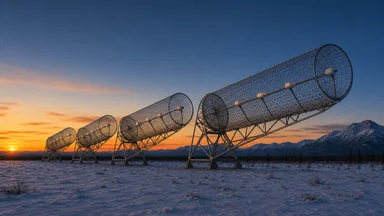
CHIME also improved localisation through interferometry. By correlating signals across its four cylindrical reflectors, it can pinpoint bursts to within a few arcminutes—not enough to identify host galaxies directly, but enough to associate them with likely counterparts. This has enabled follow-up observations with other telescopes, linking some bursts to known galaxies.
All of this came from hardware that cost a few million dollars. The receiver chain, from LNB to digitizer, was built largely from off-the-shelf components. The computational backend, which processes terabytes per day, uses commodity GPUs. The lesson is that a well-designed cheap array can outperform an expensive one for certain science questions.
Another key result from CHIME is the measurement of the FRB energy distribution. With thousands of events, the team has shown that the energy function follows a power law with an index around –1.8, meaning that for every tenfold increase in energy, the number of bursts drops by a factor of roughly 60. This steep slope explains why ASKAP, with its higher detection threshold, sees so few bursts: the vast majority of FRBs are relatively faint. The population is dominated by events with energies around 10^39 erg, while ASKAP typically sees bursts above 10^40 erg. This difference in energy threshold accounts for most of the rate discrepancy, but the exact factor depends on the shape of the luminosity function, which is still uncertain.
ASKAP's Complementary View: Bright Events and Host Galaxies
ASKAP's strength lies in its ability to localise bursts with arcsecond precision. Its phased-array feeds allow it to form multiple beams on the sky, and the array's long baselines give it high angular resolution. When ASKAP detects an FRB, it can often identify the host galaxy directly. As of late 2024, it had pinpointed roughly 20 host galaxies, providing redshifts and allowing measurements of the dispersion measure–distance relation.
This relation is crucial for using FRBs as cosmological probes. The dispersion measure—the amount of delay between different radio frequencies caused by free electrons along the line of sight—correlates with distance. ASKAP's precise positions have calibrated this relation, showing that the intergalactic medium contains about half the expected baryons. Without ASKAP's small, high-quality sample, that calibration would be much weaker.
But ASKAP's rate is too low for statistical population studies. With only a few dozen bursts, it cannot constrain the luminosity function or the redshift distribution with any confidence. The two catalogues need each other: CHIME provides the numbers, ASKAP provides the positions. Together, they paint a fuller picture than either alone.
The tension between them is not a failure but a feature. It forces modellers to account for selection effects—what each telescope sees and misses. The price threshold is a reminder that no single instrument can do everything, and that the most expensive option is not always the best.
One trade-off that is often overlooked is the impact of survey speed on the discovery of rare subclasses. For example, CHIME has discovered a handful of extremely bright FRBs that are also seen by ASKAP, but the overlap is small. These rare events may have different physical origins—perhaps from younger magnetars or from environments with unusually high magnetic fields. Without a wide-field survey like CHIME, these rare events would be missed entirely. Conversely, without a high-resolution follow-up like ASKAP, their host galaxies would remain unknown. The synergy between the two instruments is a model for future multi-wavelength and multi-instrument campaigns.
Lessons for Next-Generation Radio Surveys
Future radio surveys are already learning from the CHIME–ASKAP divide. The Deep Synoptic Array 2000 (DSA-2000), currently under construction, aims to combine both approaches. It will use 2,000 small dishes with cheap receivers, covering a wide field of view, but with enough baseline length to localise bursts precisely. The budget is roughly US$100 million, a fraction of what a traditional array of large dishes would cost.
Other projects, like the Square Kilometre Array (SKA), are also incorporating wide-field capabilities. The SKA's low-frequency component will use simple dipole antennas, similar in spirit to CHIME's LNBs, to survey large areas. The mid-frequency component will use more expensive dishes but with phased-array feeds that can observe multiple directions simultaneously. The goal is to avoid a monoculture of expensive instruments that cannot survey rapidly.
Funding agencies are beginning to value high-cadence surveys, but the shift is slow. A proposal for a cheap, wide-field telescope still faces scepticism from reviewers who equate cost with quality. The CHIME example provides a counterargument, but it may take another decade before the culture changes.
The price threshold—roughly US$500 per receiver element—is a rule of thumb that separates surveys that can see the bulk of the FRB population from those that only see the tip of the iceberg. Future projects should be designed with this threshold in mind, choosing cost-effective components that maximise discovery space.
Another lesson is the importance of open data and collaboration. CHIME's data are publicly released through the Canadian FRB database, allowing astronomers worldwide to mine the catalogues for new insights. ASKAP's data are also made available through the CSIRO's data archive. This openness accelerates science and ensures that the tension between catalogues is explored by many groups, not just the original teams. It also allows independent checks of selection effects and biases, which are essential for understanding what each survey is actually seeing.
What the Price Threshold Tells Us About Scientific Progress
Instrument cost does not linearly track discovery rate. CHIME's total budget was about one-tenth that of ASKAP, yet it discovered ten times more FRBs. The relationship is not simple, but it is clear that expensive hardware can be a liability if it limits survey speed or field of view.
Incentives can blind a field to simple solutions. For years, radio astronomers assumed that detecting FRBs required high sensitivity, so they built sensitive but narrow-field instruments. The CHIME team, constrained by budget, built a wide-field instrument that turned out to be ideal. The same dynamic can be seen in other fields: the best tool for a job is not always the most sophisticated one.
CHIME's LNB trick is repeatable in other frequency bands. Similar consumer-grade components exist for millimetre-wave and optical astronomy, though the packaging and performance differ. The principle—use cheap, mass-produced parts to cover a large area—could revolutionise other branches of time-domain astronomy.
Methodological humility is the final lesson. The two catalogues disagree not because one is wrong, but because each sees a different part of the population. The price threshold is a reminder that every instrument has blind spots, and that progress often comes from combining complementary views rather than arguing over which is correct.
In the broader context of scientific methodology, the FRB case illustrates a general principle: the design of measurement instruments inevitably shapes the phenomena we observe. This is true not only in astronomy but in any empirical science. The choice of what to measure, with what precision, and over what domain, determines what can be discovered. The CHIME–ASKAP divide is a vivid example of how a seemingly mundane decision—how much to spend on a receiver—can bifurcate a field into two incompatible catalogues. Recognising that such thresholds exist, and making them explicit, is a step toward more robust and self-aware science.